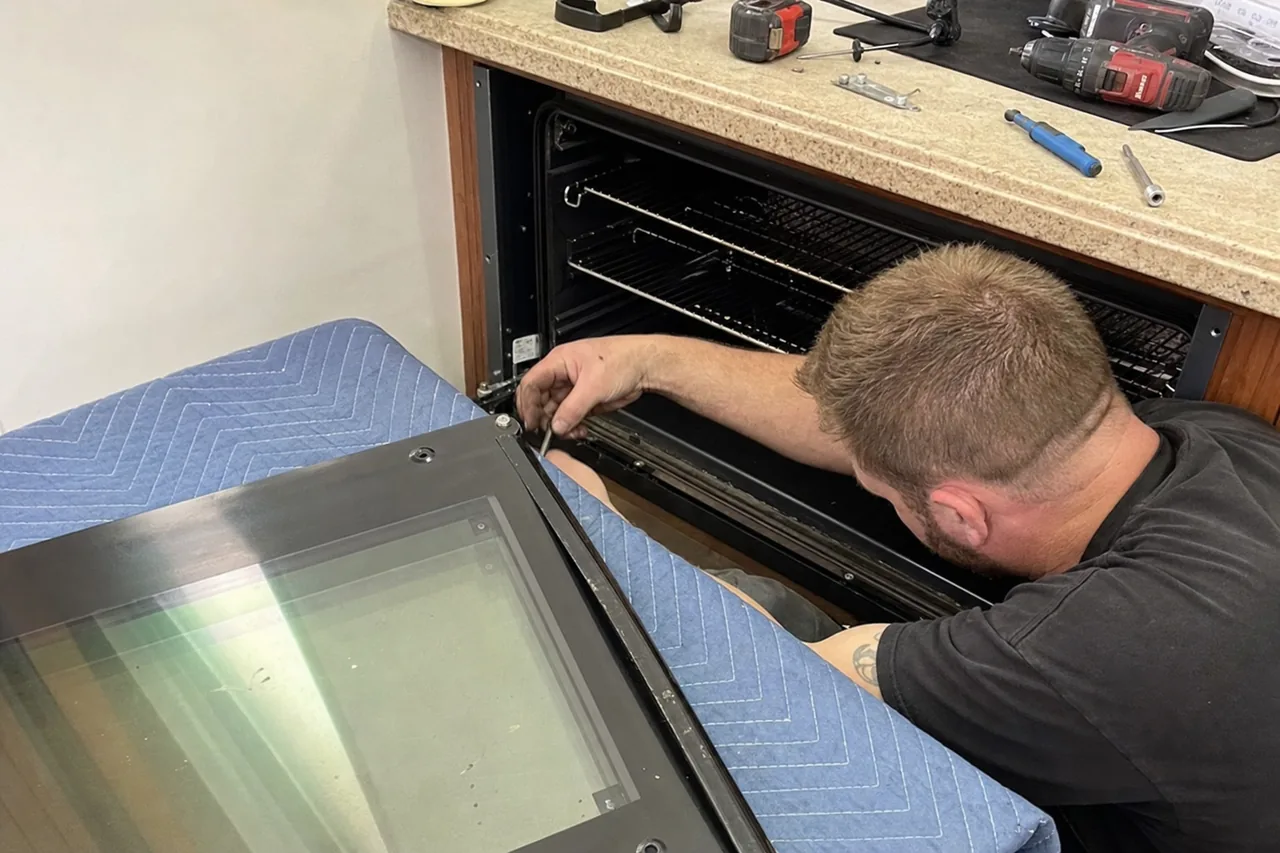
Diagnosis
Thermador Wall Oven Not Heating: What We Check
Published
An oven that will not heat is four different repairs wearing the same complaint. People describe it in the same handful of ways when they call:
- the oven runs but never reaches the temperature it was set to
- bake works and broil does not, or broil works and bake does not
- the panel lights and the cavity stays cold through the whole cycle
- everything browns hard on one side and stays pale on the other
- the oven shuts itself down part way through a long bake
- the door has stayed locked since a self-clean cycle
Each of those points somewhere different. A wall oven makes the narrowing easier than most appliances, because it can be asked direct questions.
The three-answer test
Set bake and listen. Then set broil and listen. Then look into the cavity mid-cycle.
If bake heats and broil does not, or the reverse, one element has failed and the control feeding it is working. If neither heats while the panel lights and the cooling fan spins, the element side is probably fine and the fault sits upstream — the relay that closes the circuit, or the thermostat that never asks it to. If the cavity does heat but never settles where you set it, the temperature sensor is reading the cavity wrong and the control is faithfully obeying a bad number.
Three answers, three different parts, three different bills. That is the reason a diagnostic exists at all.
Why the circuit is measured first
A wall oven in this county draws hard and draws often. Out in the retrofit belt — Riverside, Avondale, Old Ortega, the older streets of San Marco — the oven frequently sits on a circuit sized for whatever stood there decades ago, and sometimes shared with the rest of the kitchen.
An oven behind an unstable supply behaves exactly like an oven with a failing control: shutdowns with no pattern, a panel that dies and comes back, presses that register once and then do not. Fit a board behind that and it fails again, on your money. So the supply is measured before the board is condemned. Every time, and in that order.
Browning on one side is airflow
Uneven browning is not a heat complaint. On a convection oven the fan is what levels the cavity out, and when the motor is slowing, or a blade has cracked at the hub, it spins freely while moving almost nothing. The oven still reaches temperature, so the display insists everything is fine while one tray comes out dark and the other pale.
The other cause is a door that no longer seals at the top. A heavy wall-oven door settles over the years, and a few millimetres of drop at the header is enough to let the top of the cavity run cooler than the bottom.
After a self-clean
Self-clean runs the cavity far hotter than any cooking cycle, so it is the cycle that finds weaknesses. The two calls that follow one are a door that will not release — the latch motor or its switch — and an oven that will not heat at all afterwards, which is usually a thermal cut-out that did exactly what it is for. Both are ordinary parts.
If the door is locked, leave it alone rather than forcing it. A forced latch turns a small part into a damaged door.
Boards, a fortnight after the storm
The pattern here is not a board that dies during an outage. It is a board that dies two or three weeks later, far enough afterwards that nobody connects the two events. If the oven started behaving oddly a fortnight after the lights flickered, say so on the phone — it changes where we look first.
Two things worth checking yourself
Confirm the breaker has not partially tripped, which can leave a panel lit and the elements dead. Then run one empty cycle with an oven thermometer on the middle shelf: if the oven settles well away from the number you set, that is a sensor conversation, and knowing it beforehand shortens the visit.
Diagnosis · what it costs
What would this cost to put right?
A note is not a quote. What it takes to settle the fault described above starts at a flat $80 to diagnose, credited to the repair, and lands in the bands below once parts and labor are counted.
| What failed | Cost, fitted |
|---|---|
| The diagnostic visit | $80, credited |
| Bake or broil element | $200–$530 |
| Oven thermostat or temperature sensor | $170–$570 |
| Control board or touch panel | $410–$1,010 |
| Convection fan or motor | $250–$660 |
A band, not a quote. Which part failed, whether the appliance has to come out of its cabinet to reach it, and how much of it has to be stripped to get at the part all move the figure inside it, so the firm number is written down once the fault has a name. Written estimate before any part is ordered or fitted. The whole price book is on the pricing page.
Follow-up questions
What would this cost to put right?
A flat $80 diagnostic gets a technician to the kitchen and names the fault. Repairs of the kind described here run $170–$1,010 for parts and labor, with control board or touch panel ($410–$1,010) at the top of the range. Written estimate before any part is ordered or fitted.
Can I check any of this myself before booking?
Some of it. Condenser grilles, hood filters and vent paths are owner work and cost nothing to look at. Anything behind a panel, inside a sealed system or on a live circuit is not. Describe the symptom on the phone and we will say which one it is.
Which appliances does this apply to?
Wall ovens. We work on Thermador and nothing else, across Jacksonville and Duval County. EPA Section 608 certified technicians for sealed-system work.
Keep reading
Related
Flat $80 diagnostic. Written estimate first. Call (904) 395-4339