Diagnosis
Thermador Cooktop Clicking but Not Lighting
Published
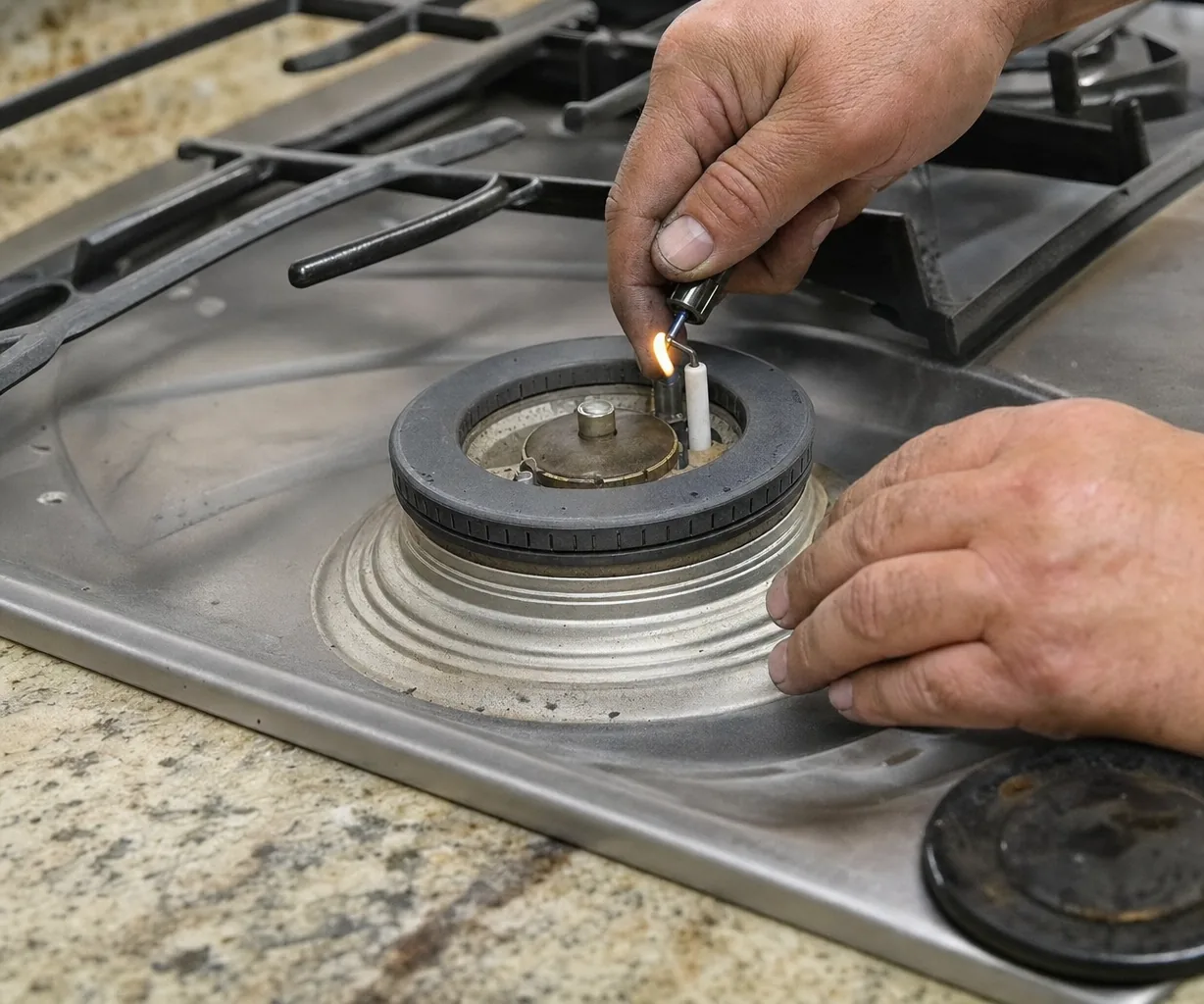
Clicking is the sound of a cooktop trying. Either the spark is being made and the gas is not catching it, or the gas is arriving and the spark is not. Almost every version of this is a cheap part, and the expensive mistake is replacing the wrong cheap part twice.
The version you have is usually obvious once you know what separates them.
Something spilled
The commonest cause by a distance is liquid. A pot boils over, some of it runs into the burner well, and the electrode ends up sitting in it. A wet electrode sparks to the nearest earth instead of across its gap, so the cooktop clicks confidently and lights nothing.
Turn everything off, lift the grate and the burner cap, and let the well dry properly — hours, not minutes, and not with a hair dryer aimed into the gas ports. Then check the cap is seated flat and square on its base. A cap sitting a fraction proud, or rotated off its locating notch, puts the flame ports out of line with the electrode and produces the identical complaint to a dead igniter.
That costs nothing, it is owner work, and it settles a fair share of these calls without a van.
Every burner clicking at once
If turning one knob makes the whole cooktop spark, the fault is in the spark module or in one of the switches feeding it. A module that has lost the ability to isolate its channels fires everything; a single switch stuck closed does the same thing from the other end.
That narrows fast. If the all-burner clicking started after a spill on one particular burner, that burner’s switch is where to look. If it started for no reason anyone can name, suspect the module. Either way the answer comes from a meter, not from a parts order.
Lights, then dies when you let go
A flame that holds while the knob is pressed and drops the instant it is released is a flame-sensing fault rather than an ignition one. The cooktop is lighting perfectly well and then deciding it cannot see what it lit. Carbon on the sensing element, a loose connection at it, or a weak valve at the far end of the circuit are the three usual causes, and they are separated on site.
Salt air, on the beach side
Kitchens in 32250, 32266 and 32233, and out toward Ponte Vedra, live in air that corrodes. On a cooktop it shows in the small metal first: the electrode tip, the spade connectors under the burner, the earth strap at the chassis. A corroded connector does not fail cleanly. It works while the kitchen is cool, misses once everything is hot, and behaves again the next morning — which is why an intermittent cooktop out there is worth looking at rather than living with.
Inland, the same intermittence is more often a switch worn by use.
Yellow flame, lazy simmer
Colour is an air-and-gas question, not an ignition one. A yellow, lazy flame on one burner while its neighbours burn blue points at a blocked port, a displaced cap, or a burner head that needs cleaning out properly. A cooktop that will not hold a low simmer anywhere is a different matter — that is regulation or valve work, and it is the version of this complaint worth booking rather than poking at.
We do not adjust supply pressure at the meter. That belongs to the gas utility, and when the fault turns out to sit there we say so and stop.
What the visit looks at
The spark at the electrode, the continuity of each switch, the earth path, and the cap and port geometry — in that order, before anything is ordered.
Diagnosis · what it costs
What would this cost to put right?
A note is not a quote. What it takes to settle the fault described above starts at a flat $80 to diagnose, credited to the repair, and lands in the bands below once parts and labor are counted.
| What failed | Cost, fitted |
|---|---|
| The diagnostic visit | $80, credited |
| Igniter, spark module or surface element | $200–$500 |
| Control board or touch panel | $410–$1,010 |
A band, not a quote. Which part failed, whether the appliance has to come out of its cabinet to reach it, and how much of it has to be stripped to get at the part all move the figure inside it, so the firm number is written down once the fault has a name. Written estimate before any part is ordered or fitted. The whole price book is on the pricing page.
Follow-up questions
What would this cost to put right?
A flat $80 diagnostic gets a technician to the kitchen and names the fault. Repairs of the kind described here run $200–$1,010 for parts and labor, with control board or touch panel ($410–$1,010) at the top of the range. Written estimate before any part is ordered or fitted.
Can I check any of this myself before booking?
Some of it. Condenser grilles, hood filters and vent paths are owner work and cost nothing to look at. Anything behind a panel, inside a sealed system or on a live circuit is not. Describe the symptom on the phone and we will say which one it is.
Which appliances does this apply to?
Gas cooktops. We work on Thermador and nothing else, across Jacksonville and Duval County. EPA Section 608 certified technicians for sealed-system work.
Keep reading
Related
Flat $80 diagnostic. Written estimate first. Call (904) 395-4339