Salt air
Salt Air, Condensers and Why Beach Kitchens Age Faster
Published
Everything in a beachside kitchen breathes salt. Not spray, and not obviously — just air with chloride in it, moving across metal for years.
Along the Duval and northern St. Johns coast, that means 32250 in Jacksonville Beach, 32233 in Atlantic Beach, 32082 in Ponte Vedra Beach, 32266 in Neptune Beach and 32084 in St. Augustine. Move a mile or two inland and the effect drops off sharply.
The condenser is the expensive one
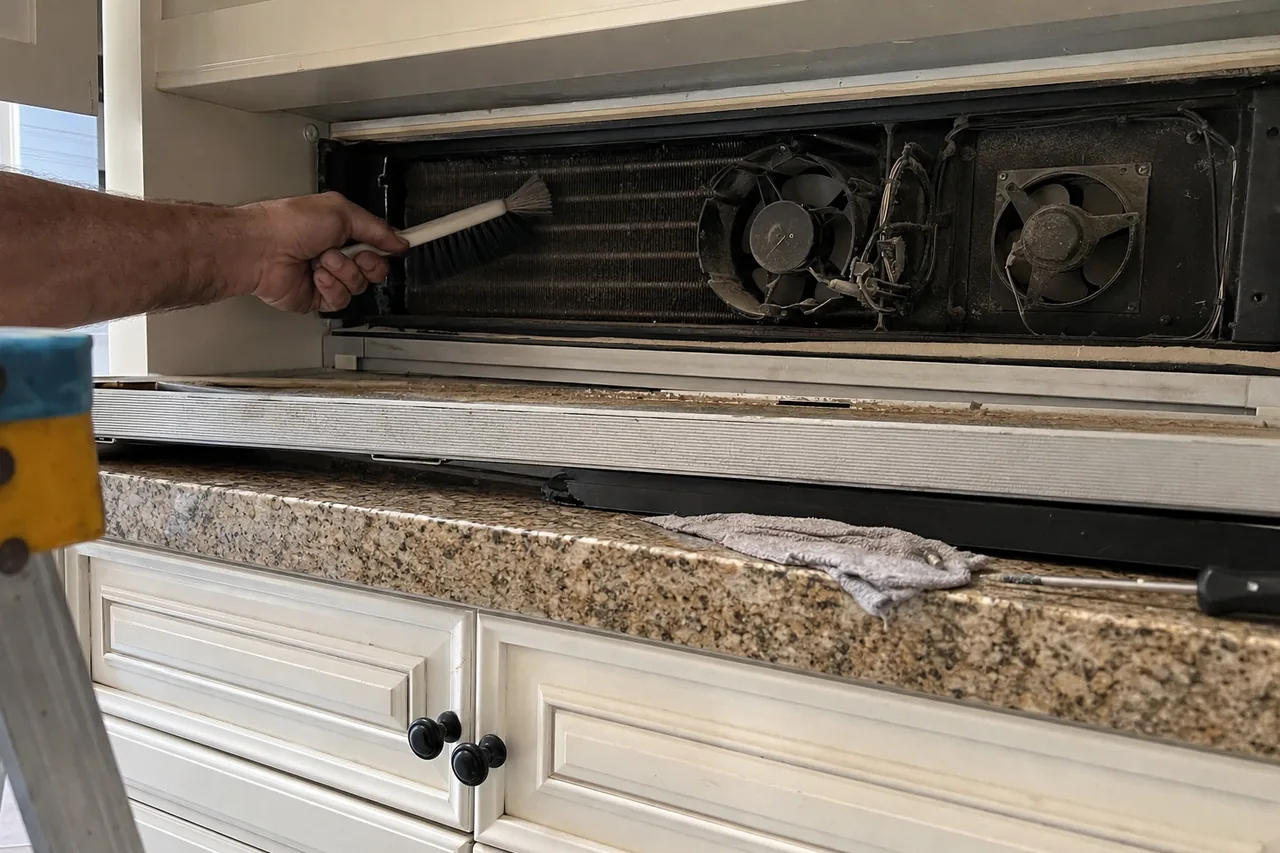
A column refrigerator rejects its heat through a condenser behind the toe grille. That coil breathes whatever the room breathes.
Salt accelerates corrosion on the aluminium fins. As they corrode, the gaps between them close and the effective surface area falls. Heat rejection drops. The compressor runs longer to hold the same setpoint, and on a hot afternoon the cabinet drifts warm anyway.
The complaint arrives as “it is not keeping temperature”, which sounds like a refrigerant problem. Frequently it is a coil that can no longer do its job.
This is why we pull the toe grille first on every coastal call. It is also why we tell beachside owners to vacuum the condenser twice a year rather than once.
Hinges and door seals
Tall column doors seal at the header because the hinge geometry holds them there. That geometry has very little tolerance.
Corroded hinge hardware allows the door to sag a few millimetres at the top. That is enough to break the seal, let humid air in, trigger a door alarm with the door apparently shut, and ice up the rear wall within days.
Owners usually blame the gasket. The gasket is often fine. The door is simply no longer where the gasket needs it to be.
Exterior dampers
Ventilation suffers the most visible salt damage, and almost none of it is visible from the kitchen.
A wall or roof cap contains a damper that opens under blower pressure and falls shut when the hood is off. Salt attacks the pivot.
A damper corroded open lets humid outside air back into the kitchen constantly. You get a warm draught over the cooktop and a cabinet that smells damp.
A damper corroded shut throttles the hood to nothing while the blower still sounds strong. That is the classic coastal complaint: full fan speed, smoke still crossing the room.
Neither fault is inside the hood, which is why we check the termination before recommending a motor.
Stainless is not immune
Stainless steel resists corrosion; it does not ignore it. Chloride attacks the passive layer and produces pitting, usually starting at welds, seams and screw heads where the finish is thinnest.
Once pitting has started it does not reverse. Regular fresh-water wiping and prompt removal of standing salt residue slows it considerably.
What is worth doing
Rinse exterior hood caps with fresh water twice a year. Vacuum the refrigerator condenser twice a year. Wipe stainless with fresh water rather than leaving coastal residue to sit. Check that a hood damper actually falls shut when the blower stops.
None of it is difficult. All of it buys years.
When it has gone too far
A condenser that has lost its fin structure cannot be cleaned back to health, and a seized exterior damper is a replacement rather than a service item.
We will tell you which situation you are in before anything is ordered. Flat $80 diagnostic, credited toward the repair, and a written estimate first.
Salt air · what it costs
What would this cost to put right?
A note is not a quote. What it takes to settle the fault described above starts at a flat $80 to diagnose, credited to the repair, and lands in the bands below once parts and labor are counted.
| What failed | Cost, fitted |
|---|---|
| The diagnostic visit | $80, credited |
| Igniter, spark module or surface element | $200–$500 |
| Oven thermostat or temperature sensor | $170–$570 |
| Bake or broil element | $200–$530 |
| Convection fan or motor | $250–$660 |
| Control board or touch panel | $410–$1,010 |
| Door hinge, glass or seal | $180–$700 |
| Refrigeration column sealed system | $910–$2,270 |
A band, not a quote. Which part failed, whether the appliance has to come out of its cabinet to reach it, and whether the sealed system is opened all move the figure inside it, so the firm number is written down once the fault has a name. Written estimate before any part is ordered or fitted. The whole price book is on the pricing page.
Follow-up questions
What would this cost to put right?
A flat $80 diagnostic gets a technician to the kitchen and names the fault. Repairs of the kind described here run $170–$2,270 for parts and labor, with refrigeration column sealed system ($910–$2,270) at the top of the range. Written estimate before any part is ordered or fitted.
Can I check any of this myself before booking?
Some of it. Condenser grilles, hood filters and vent paths are owner work and cost nothing to look at. Anything behind a panel, inside a sealed system or on a live circuit is not. Describe the symptom on the phone and we will say which one it is.
Which appliances does this apply to?
Column refrigeration, ventilation, dishwashers. We work on Thermador and nothing else, across Jacksonville and Duval County. EPA Section 608 certified technicians for sealed-system work.
Salt air
What owners said after the visit
★★★★★
Three blocks from the ocean, the condenser had matted into a grey felt and the column ran without ever satisfying. He cleaned it back to bare fin, checked the fan draw, and showed me how to keep on top of it.
Cornelius P.
★★★★★
Ice was building in the drawer and the door had stopped sealing along the top edge. He set the hinge, fitted a tired gasket and vacuumed a condenser I had never once looked at. Everything shuts properly now.
Delphine A.
★★★★☆
The compressor ran without pause and the cabinet never reached its setting. He read the pressures, found a restriction and dealt with it properly. It took two visits and a fair wait for parts, but the reading holds.
Horace B.
Keep reading
Related
Flat $80 diagnostic. Written estimate first. Call (904) 395-4339